
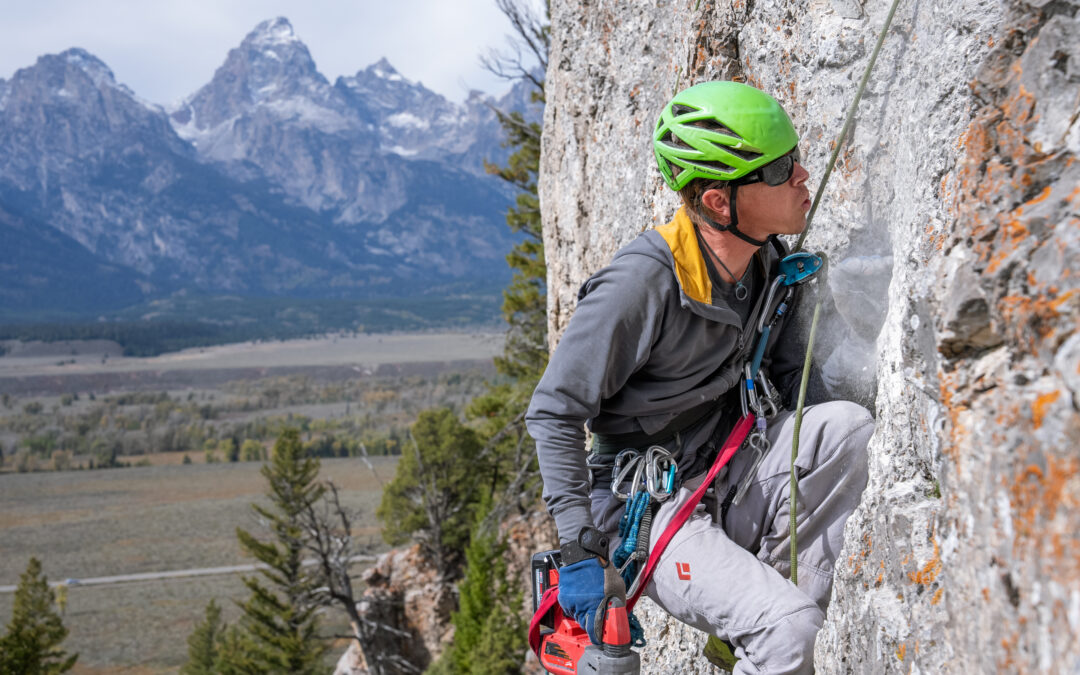
The Teton Climbers’ Coalition (TCC) has announced its 2026 Climbing Area Modernization (CAM) Project priorities, continuing its work to replace aging hardware, improve safety, and steward high-use climbing areas across the Jackson Hole region.
Building on momentum from previous seasons, the 2026 CAM Project will focus on targeted upgrades at Goat Cave, Boulder Island, and Rock Springs Buttress (RSB), while advancing best practices for bolt replacement and strengthening partnerships within the climbing community.
The TCC will host a series of rebolting clinics throughout the season, providing hands-on training while replacing aging hardware in one of the area’s most accessible and heavily used crags. At Goat Cave, planning is already underway following a March 16 coordination meeting with Bridger-Teton National Forest staff (BTNF).
Work at Boulder Island will move forward in coordination with Grand Teton National Park. The TCC is committed to working closely with both the Park and BTNF to ensure all improvements meet regulatory standards while addressing the needs of the climbing community.
At Rock Springs Buttress, the TCC will continue its ongoing audit of fixed hardware, identifying priority areas for replacement and maintenance.
In parallel, TCC has formally adopted the American Safe Climbing Association’s (ASCA) best practices for bolt replacement, reinforcing its commitment to nationally recognized standards for safety and durability. These guidelines emphasize the use of corrosion-resistant materials—typically stainless steel in mountain environments—appropriate bolt sizing based on rock quality and usage, and strict adherence to manufacturer specifications for placement, torque, and installation.
ASCA’s approach also prioritizes minimizing impact to the rock itself: reusing and expanding original bolt holes whenever possible, avoiding the addition of new bolts, and patching and camouflaging old holes to preserve the natural character of the rock. Anchor systems are designed with long-term use in mind, incorporating durable components such as rings, chains, or steel hooks, while reducing visual impact wherever feasible.
“The CAM Project is about taking responsibility for the places in which we climb,” said Christian Beckwith, Executive Director of the Teton Climbers’ Coalition. “By aligning our work with ASCA’s best practices, we’re ensuring that replacements are not only safer, but also more durable and more respectful of the resource.”
The CAM Project is a core component of TCC’s stewardship mission, addressing aging infrastructure while fostering a culture of shared responsibility among climbers.